High-Yield Savings Accounts 2026: Best 5% APR Options
High-Yield Savings Accounts 2026: Unlocking the Best 5% APR for Your Dollars
In the ever-evolving landscape of personal finance, finding the optimal place to store your hard-earned money while ensuring it grows significantly is a perennial challenge. As we look towards 2026, the pursuit of competitive interest rates, particularly a robust high-yield savings accounts offering an impressive 5% Annual Percentage Yield (APR), remains a top priority for savvy savers. The financial market is dynamic, influenced by economic policies, inflation, and global events, all of which impact the rates banks can offer. Therefore, staying informed about the best options for high-yield savings accounts is crucial for maximizing your financial potential.
Gone are the days when traditional savings accounts offered negligible returns. With the rise of online banks and increased competition, high-yield savings accounts have become a cornerstone of smart financial planning, providing a much-needed boost to your savings without the inherent risks associated with investment vehicles like stocks or mutual funds. For many, a 5% APR represents a significant milestone, transforming stagnant cash into a powerful growth engine. This comprehensive guide will delve into the world of high-yield savings accounts in 2026, exploring the best options available, what to look for, and how to position yourself to take advantage of the most attractive rates.
Whether you’re saving for a down payment, an emergency fund, a dream vacation, or simply looking to make your money work harder for you, understanding the nuances of high-yield savings accounts is paramount. We’ll break down the key features, potential pitfalls, and expert strategies to help you navigate the choices and secure the best possible return on your savings. Prepare to transform your financial future by making informed decisions about where your money resides.
Understanding High-Yield Savings Accounts: Why 5% APR Matters
Before diving into specific banks and their offerings, it’s essential to grasp what makes high-yield savings accounts so appealing, particularly when they offer a 5% APR. Unlike standard savings accounts found at brick-and-mortar banks, high-yield savings accounts typically offer interest rates significantly higher than the national average. This difference can translate into hundreds, or even thousands, of dollars in additional earnings over time, depending on your balance.
What is APR and APY?
When discussing high-yield savings accounts, you’ll often encounter terms like APR (Annual Percentage Rate) and APY (Annual Percentage Yield). While often used interchangeably, there’s a subtle but important distinction. APR represents the annual rate of interest paid, without taking into account the effect of compounding. APY, on the other hand, reflects the total amount of interest earned on a deposit over a year, taking into account the effect of compounding interest. For savers, APY is the more accurate measure of how much money you’ll actually earn, as it accounts for interest earning interest. When we refer to a 5% APR in the context of high-yield savings accounts, we are generally implying a rate that, considering compounding, will result in a competitive APY, often close to or exceeding 5%.
The Power of Compounding Interest
The magic behind high-yield savings accounts, especially those with a 5% APR, lies in compounding interest. Compounding means that the interest you earn is added to your principal, and then that new, larger principal earns interest. This snowball effect can dramatically accelerate the growth of your savings over time. With a 5% APR, your money grows exponentially faster than it would in a traditional account offering a meager 0.01% or even 1%.
Consider this: if you deposit $10,000 into a high-yield savings account with a consistent 5% APY, after one year, you’d have $10,500. After ten years, without any additional deposits, your initial $10,000 would grow to approximately $16,288.95. Compare that to a traditional account earning 0.01% APY, where it would barely budge. This illustrative power of compounding underscores why seeking out the best high-yield savings accounts is a critical financial strategy.
Why are High-Yield Accounts Often Online?
A significant number of the most competitive high-yield savings accounts are offered by online-only banks. This isn’t a coincidence. Online banks typically have lower overhead costs compared to traditional banks with extensive physical branch networks. They don’t have to pay for rent, utilities, and staff for numerous locations. These cost savings are often passed on to customers in the form of higher interest rates, making their high-yield savings accounts more attractive.
Key Factors When Choosing a High-Yield Savings Account in 2026
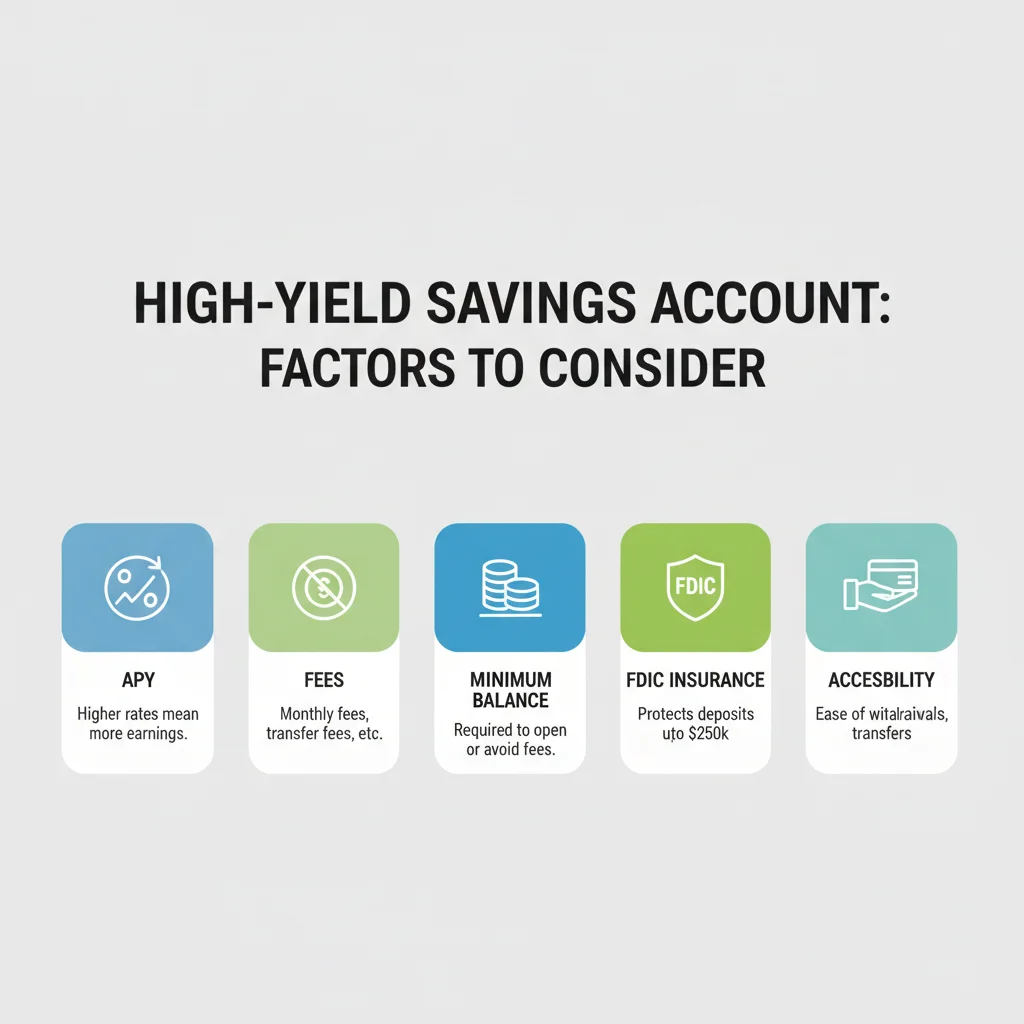
While a 5% APR is a fantastic target, it’s not the only factor to consider when selecting the best high-yield savings accounts. A holistic approach ensures you choose an account that aligns perfectly with your financial habits and needs. Here are the crucial elements to evaluate:
1. Annual Percentage Yield (APY)
As discussed, the APY is paramount. Always compare APYs, not just stated APRs, to get the clearest picture of your potential earnings. Be wary of introductory rates that may drop after a certain period. Look for consistent, competitive rates on high-yield savings accounts.
2. Fees and Minimum Balance Requirements
Some high-yield savings accounts come with monthly maintenance fees that can eat into your earnings. Many online banks offer fee-free accounts, but it’s crucial to confirm. Additionally, some accounts require a minimum balance to earn the advertised APY or to avoid fees. Ensure you can comfortably meet these requirements without tying up too much of your liquidity.
3. FDIC or NCUA Insurance
This is non-negotiable. Always ensure your high-yield savings accounts are insured by the Federal Deposit Insurance Corporation (FDIC) for banks or the National Credit Union Administration (NCUA) for credit unions. This insurance protects your deposits up to $250,000 per depositor, per institution, in case of bank failure. This provides peace of mind, knowing your savings are secure.
4. Accessibility and Transfer Options
How easily can you access your money? While high-yield savings accounts are generally not designed for frequent transactions, you should be able to transfer funds to and from linked checking accounts without excessive delays or fees. Look for accounts with seamless online banking platforms, mobile apps, and convenient electronic transfer options (e.g., ACH transfers, Zelle integration). Remember, federal regulations (Regulation D) historically limited certain withdrawals/transfers from savings accounts to six per month, though this was temporarily suspended during the pandemic. While many banks still adhere to this or have their own limits, it’s wise to check the specifics for each high-yield savings accounts.
5. Customer Service and Online Tools
Even with online-only banks, good customer service is vital. Check reviews for responsiveness and helpfulness. A user-friendly online interface and mobile app can significantly enhance your banking experience. Look for features like budgeting tools, spending trackers, and easy statement access.
6. Promotional Offers and Bundling
Some banks offer bonus interest rates for new customers or when you meet certain criteria, such as setting up direct deposit or maintaining a specific balance. While these can be attractive, always read the fine print to understand the long-term rate after the promotional period ends. Also, consider if bundling your high-yield savings accounts with a checking account at the same institution offers additional benefits or higher rates.

Top Contenders for High-Yield Savings Accounts with 5% APR in 2026
Predicting exact rates for 2026 is challenging, as they are subject to market fluctuations and Federal Reserve policy. However, we can identify types of institutions and common strategies they employ to offer competitive high-yield savings accounts. It’s crucial to remember that a consistent 5% APY is ambitious and often comes with specific caveats. Banks offering such rates typically fall into a few categories:
Online Banks and Fintech Companies
These are consistently at the forefront of offering the best rates for high-yield savings accounts. Their lower overhead allows them to pass savings onto customers. In 2026, expect names like:
- Ally Bank: Known for consistently competitive rates, user-friendly digital tools, and no monthly fees or minimum balance requirements. They often offer rates in the higher tiers.
- Synchrony Bank: Frequently features among the top-tier high-yield savings accounts, offering strong APYs with no monthly fees.
- Discover Bank: Beyond credit cards, Discover offers robust high-yield savings accounts with competitive rates and excellent customer service.
- Marcus by Goldman Sachs: A strong contender in the online savings space, Marcus offers attractive rates with minimal fees and a straightforward platform.
- Capital One 360 Performance Savings: Offers a solid APY with no fees or minimums, integrated with Capital One’s broader suite of banking products.
While these banks might not always hit exactly 5% APY at all times, they are the most likely candidates to approach or exceed it when market conditions are favorable. It’s important to check their current offerings as 2026 approaches.
Credit Unions with Specific Membership Requirements
Some credit unions can offer exceptionally high rates, sometimes reaching or exceeding 5% on their high-yield savings accounts. However, these often come with specific membership requirements (e.g., living in a certain area, working for a specific company, or joining an affiliated organization) and sometimes require maintaining a checking account or meeting other conditions. Examples might include smaller, regional credit unions that are highly localized.
Fintech Platforms with Tiered Rates or Specific Conditions
A new breed of fintech companies and neobanks are entering the market, some promising very high APYs. These often come with conditions such as:
- Tiered Rates: A 5% APR might only apply to a certain balance threshold (e.g., up to $5,000 or $10,000), with lower rates applying to balances above that. This is a common strategy for offering very attractive rates on smaller sums.
- Direct Deposit Requirements: You might need to set up direct deposit to qualify for the highest rates.
- Debit Card Usage: Some platforms tie higher rates to a certain number of debit card transactions per month.
- Subscription Fees: A few platforms might charge a monthly subscription fee, which could offset some of the interest earned.
Always scrutinize the terms and conditions for these types of high-yield savings accounts to ensure the advertised rate is genuinely beneficial for your situation.
Strategies to Maximize Your High-Yield Savings in 2026
Simply opening a high-yield savings accounts isn’t enough; strategic management can significantly boost your returns. Here’s how to make the most of your 5% APR account:
1. Automate Your Savings
Set up automatic transfers from your checking account to your high-yield savings accounts every payday. Even small, consistent contributions add up quickly, benefiting from the power of compounding at a 5% APR.
2. Consolidate Your Savings
If you have money spread across multiple low-interest accounts, consider consolidating it into one or two top-tier high-yield savings accounts. This not only simplifies management but also ensures every dollar is earning the highest possible rate.
3. Monitor Interest Rates Regularly
The financial market is fluid. What’s the best high-yield savings accounts today might not be tomorrow. Make it a habit to check rates periodically (e.g., quarterly or biannually). If another institution offers a significantly higher APY, don’t hesitate to switch. The ease of transferring funds between online banks makes this a straightforward process.
4. Understand Your Financial Goals
Are you saving for a short-term goal (e.g., an emergency fund, a vacation) or a medium-term goal (e.g., a down payment)? High-yield savings accounts are ideal for funds you need to access within a few years, as they offer liquidity without market volatility. For longer-term goals, consider diversifying with investment accounts, but always maintain a robust emergency fund in a high-yield account.
5. Leverage Tiered Accounts Wisely
If you opt for a tiered high-yield savings accounts that offers 5% APR only on a certain balance, ensure you understand how much of your money will qualify for that top rate. If you have a significantly larger sum, you might consider splitting it across multiple accounts or finding an account with a uniform high rate across all balances.
The Future of High-Yield Savings Accounts in 2026
Several factors will influence the landscape of high-yield savings accounts in 2026:
Federal Reserve Policy
The Federal Reserve’s decisions on the federal funds rate have a direct impact on interest rates offered by banks. If the Fed continues to maintain a hawkish stance or raises rates, high-yield savings accounts rates are likely to remain elevated or even increase. Conversely, a dovish stance could lead to a decline.
Competition Among Online Banks
The fierce competition among online banks and fintech platforms will likely continue to drive innovation and competitive rates. These institutions are constantly vying for deposits, which often translates to better deals for consumers seeking high-yield savings accounts.
Inflationary Pressures
High inflation often prompts central banks to raise interest rates to cool the economy. If inflationary pressures persist into 2026, banks might need to offer higher rates on high-yield savings accounts to attract and retain deposits, as consumers seek to preserve their purchasing power.
Technological Advancements
Expect further integration of AI, personalized financial advice, and seamless user experiences within banking apps. These advancements can make managing your high-yield savings accounts even easier and more intuitive.
Potential Downsides and Considerations
While high-yield savings accounts are overwhelmingly positive, there are a few considerations:
- Rate Volatility: Unlike Certificates of Deposit (CDs), the APY on high-yield savings accounts is variable and can change at any time based on market conditions.
- Transaction Limits: As mentioned, some accounts may still adhere to or impose limits on monthly withdrawals or transfers.
- No Physical Branches: For those who prefer in-person banking, online-only high-yield savings accounts might be a minor adjustment. However, most offer excellent digital support.
- Tiered Rate Complexity: If an account has tiered rates, ensure you understand how your balance will be affected.
Conclusion: Your Path to Maximized Savings in 2026
As we approach 2026, the landscape for high-yield savings accounts promises exciting opportunities for savers. Targeting a 5% APR is an ambitious yet achievable goal, especially by focusing on online banks and fintech platforms that are consistently at the forefront of offering competitive rates. By understanding the critical factors—APY, fees, insurance, and accessibility—and adopting smart saving strategies, you can significantly enhance your financial growth.
Don’t let your money sit idly in low-interest accounts. Take the proactive step to research, compare, and switch to a high-yield savings accounts that aligns with your financial aspirations. The effort put into finding the best 5% APR account will undoubtedly pay dividends, literally, and contribute significantly to your overall financial well-being. Start your journey today towards smarter saving and a more prosperous future.
Remember, the key to successful financial management lies in continuous learning and adaptation. Stay informed about market trends, regularly review your account options, and always prioritize accounts that offer FDIC or NCUA insurance for ultimate peace of mind. Your money deserves to work as hard as you do, and a top-tier high-yield savings accounts is the perfect vehicle to make that happen in 2026 and beyond.