
Maximizing Social Security Benefits in 2026: A Step-by-Step Guide to Claiming Strategies
For millions of Americans, Social Security represents a cornerstone of their retirement income. Understanding how to maximize Social Security benefits is not just about receiving a check; it’s about making informed decisions that can significantly impact your financial well-being for decades. As we look towards 2026, the landscape of Social Security benefits continues to evolve, making it crucial to stay updated on the latest rules, strategies, and considerations. This comprehensive guide will equip you with the knowledge to make the most of your Social Security entitlements, ensuring a more secure and comfortable retirement.
Understanding the Basics of Social Security Benefits
Before diving into advanced strategies to maximize Social Security benefits, it’s essential to grasp the fundamental principles of how Social Security works. Social Security is a pay-as-you-go system, primarily funded by payroll taxes. During your working years, you pay into the system, and those contributions earn you credits. To be eligible for retirement benefits, you generally need to accumulate 40 credits, which typically translates to 10 years of work.
Your Social Security benefit amount is calculated based on your highest 35 years of earnings, adjusted for inflation. This calculation determines your Primary Insurance Amount (PIA), which is the benefit you would receive if you claim at your Full Retirement Age (FRA). The FRA varies depending on your birth year. For those born in 1960 or later, your FRA is 67. Understanding your FRA is paramount, as it serves as the baseline for determining how much your benefits will increase or decrease based on your claiming age.
Key Terms to Know:
- Primary Insurance Amount (PIA): Your full benefit amount at your Full Retirement Age.
- Full Retirement Age (FRA): The age at which you are entitled to 100% of your PIA.
- Delayed Retirement Credits (DRCs): Additional benefits earned for each month you delay claiming past your FRA, up to age 70.
- Early Retirement: Claiming benefits before your FRA, which results in a permanent reduction.
The Critical Decision: When to Claim Your Benefits
The single most impactful decision regarding your Social Security is when to start claiming your benefits. This choice can lead to a difference of tens or even hundreds of thousands of dollars over your lifetime. While many people choose to claim as early as possible at age 62, this often means accepting a significantly reduced monthly payment. Conversely, delaying your claim can lead to substantially higher monthly benefits.
Claiming at Age 62 (Early Retirement)
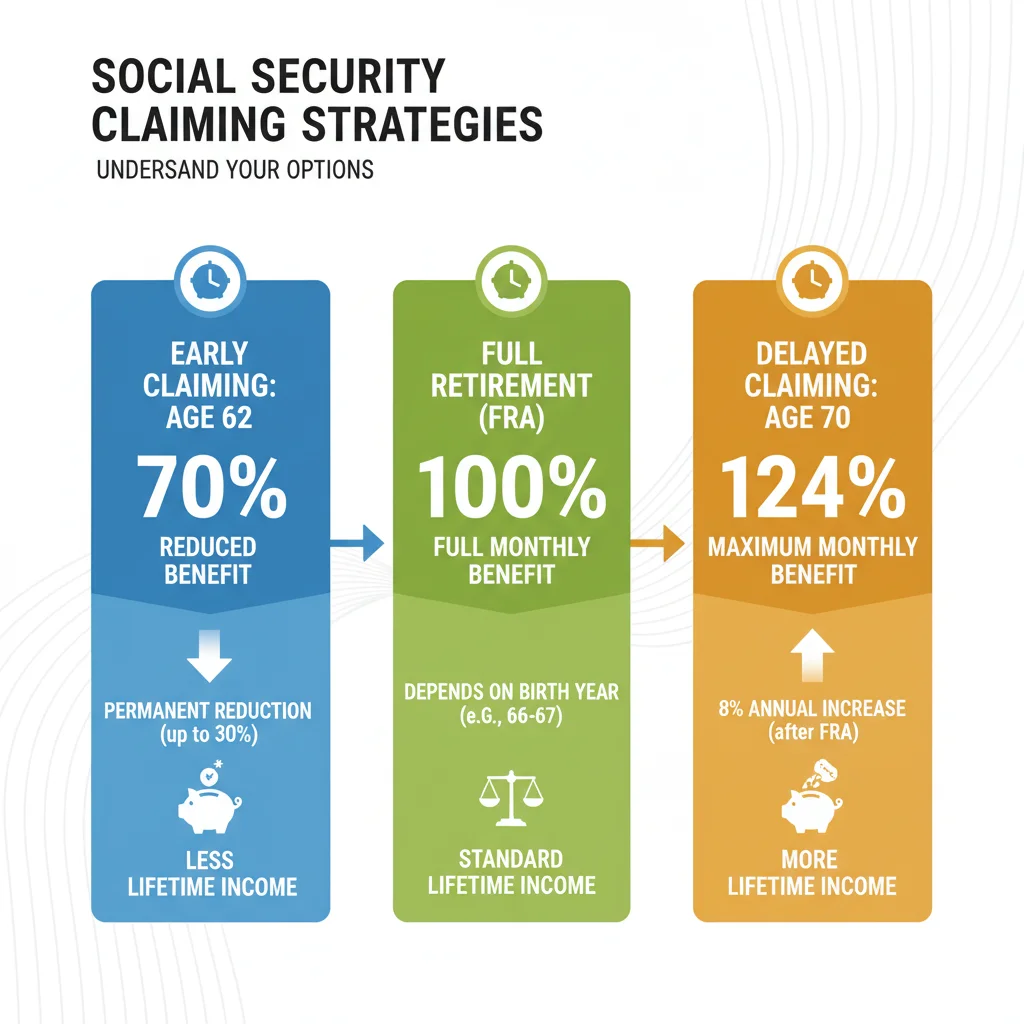
Claiming benefits at age 62, the earliest possible age, results in a permanent reduction of your monthly benefit. The reduction can be as much as 30% if your FRA is 67. While this option provides income sooner, it locks in a lower monthly payment for the rest of your life. This strategy might be suitable for individuals who:
- Are in poor health and do not expect to live a long life.
- Are no longer able to work due to health issues or job loss.
- Have other substantial income sources and don’t need the maximum Social Security benefit.
- Wish to use the funds to invest, though this carries inherent risks.
It’s also important to be aware of the earnings limit if you claim early and continue to work. If you earn above a certain threshold, a portion of your Social Security benefits will be withheld. For 2026, this limit will likely be adjusted, so staying informed is crucial. Once you reach your FRA, these earnings limits no longer apply, and any withheld benefits due to earnings will be factored back into your benefit calculation, increasing it slightly.
Claiming at Full Retirement Age (FRA)
Claiming at your FRA means you receive 100% of your Primary Insurance Amount (PIA). For those born in 1960 or later, this is age 67. This option provides a balanced approach, avoiding the reductions of early claiming while still providing benefits before the maximum possible age. It’s often a good choice for individuals who are still working but want to begin receiving benefits, or for those who are ready to retire and want their full entitlement.
Delaying Until Age 70 (Delayed Retirement Credits)
This is often the most powerful strategy to maximize Social Security benefits for individuals who are in good health and have other financial resources to cover their expenses until age 70. For each year you delay claiming past your FRA, your benefit increases by approximately 8% per year, up to age 70. This translates to an additional 24% on top of your PIA if your FRA is 67 and you delay until 70. This 8% annual increase is guaranteed and compounded, making it an excellent return on investment, especially in today’s low-interest-rate environment.
For example, if your PIA at age 67 is $2,000, delaying until age 70 could boost your monthly benefit to around $2,480. Over a long retirement, this difference can amount to hundreds of thousands of dollars. Consider this option if you:
- Are in excellent health and anticipate a long lifespan.
- Have sufficient savings or other income sources to cover expenses until age 70.
- Are still working and don’t need the income immediately.
- Want to provide a higher survivor benefit for your spouse.
The decision of when to claim is highly personal and depends on various factors, including your health, financial situation, other retirement income, and family circumstances. It’s not a one-size-fits-all answer, and careful consideration is required.
Advanced Strategies to Maximize Social Security Benefits for Couples
For married couples, the opportunities to maximize Social Security benefits become even more complex and potentially rewarding. There are specific strategies that can significantly increase the total lifetime benefits received by a couple.
Spousal Benefits
If you are married, you may be eligible to receive spousal benefits based on your spouse’s work record. A spousal benefit can be up to 50% of your spouse’s PIA. To claim a spousal benefit, your spouse must have already filed for their own retirement benefits. You must also be at least 62 years old, or any age if caring for a child under 16 or disabled.
It’s important to note that if you are eligible for both your own retirement benefit and a spousal benefit, Social Security will pay you the higher of the two amounts. You cannot receive both simultaneously. The spousal benefit is also reduced if claimed before your own FRA.
File and Suspend (No Longer Available for New Filers)
While the ‘file and suspend’ strategy was a popular method for couples to maximize Social Security benefits, it was largely eliminated by the Bipartisan Budget Act of 2015. Under the old rules, one spouse could file for their benefits at FRA, immediately suspend them, and continue earning delayed retirement credits. This allowed the other spouse to claim a spousal benefit based on the first spouse’s record, while the first spouse’s benefit continued to grow. This option is no longer available for those who were not already 62 by January 2, 2016.
Restricted Application (No Longer Available for New Filers)
Similar to file and suspend, the ‘restricted application’ strategy allowed individuals who reached FRA to file only for spousal benefits, letting their own retirement benefit continue to grow until age 70. This was an excellent way to maximize Social Security benefits for couples where one spouse had significantly higher earnings. However, this strategy is also generally unavailable for those who were not 62 by January 2, 2016. If you were born on or before January 1, 1954, you may still be eligible to file a restricted application for spousal benefits at your FRA, allowing your own benefits to grow until age 70.
Survivor Benefits
If your spouse passes away, you may be eligible for survivor benefits. A surviving spouse can receive 100% of the deceased spouse’s benefit (including any delayed retirement credits the deceased spouse earned). The earliest age a surviving spouse can claim benefits is 60 (or 50 if disabled). If you claim survivor benefits before your own FRA, they will be reduced. You can switch to your own retirement benefit later if it is higher than your survivor benefit, typically at your FRA or age 70. This flexibility is a critical component of how to maximize Social Security benefits in the event of a spouse’s death.
Coordination Strategies for Couples
Even without ‘file and suspend’ or ‘restricted application’ for new filers, couples still have powerful coordination strategies. The general principle is often for the higher-earning spouse to delay claiming until age 70 to maximize their benefit, which also provides the highest possible survivor benefit for the lower-earning spouse. The lower-earning spouse might claim their own benefits earlier, or claim a spousal benefit if it’s higher, providing some income while the higher earner’s benefit grows.
For example, if one spouse has a significantly higher PIA, they might delay claiming until age 70. The other spouse, if their own PIA is lower, could claim their own benefits at their FRA or even earlier if needed. This provides income to the household while the larger benefit grows. When the higher earner claims at 70, the lower earner can then switch to a spousal benefit if it’s higher than their own current benefit. This requires careful planning and often involves projecting lifespans and total lifetime benefits for both individuals.
Impact of Taxation on Social Security Benefits
A common misconception is that Social Security benefits are entirely tax-free. In reality, a portion of your benefits may be subject to federal income tax, and in some states, even state income tax. Understanding these rules is crucial for accurate retirement income planning and to truly maximize Social Security benefits.
Federal Taxation
The amount of your Social Security benefits that are taxable depends on your ‘combined income.’ Combined income is calculated as your adjusted gross income (AGI) plus non-taxable interest plus one-half of your Social Security benefits. Here’s a general breakdown:
- Up to 50% of your benefits may be taxable if your combined income is between $25,000 and $34,000 for an individual, or between $32,000 and $44,000 for a married couple filing jointly.
- Up to 85% of your benefits may be taxable if your combined income is above $34,000 for an individual, or above $44,000 for a married couple filing jointly.
These thresholds are not indexed for inflation, meaning that as your other retirement income (pensions, 401(k) withdrawals, investment income) increases over time, a larger portion of your Social Security benefits may become taxable.
State Taxation
Most states do not tax Social Security benefits. However, a handful of states do. As of recent years, these states included Colorado, Connecticut, Kansas, Minnesota, Missouri, Montana, Nebraska, New Mexico, Rhode Island, Utah, Vermont, and West Virginia. It’s important to check the current tax laws in your state of residence, as these can change. If you live in one of these states, the state income tax on your Social Security benefits will further impact your net benefit.
Strategies to Mitigate Taxation
While you can’t entirely avoid taxation on Social Security if your income is high enough, there are strategies that can help manage your combined income and potentially reduce the taxable portion of your benefits:
- Roth Conversions: Converting traditional IRA or 401(k) funds to a Roth IRA in years prior to claiming Social Security can reduce future taxable withdrawals, thereby lowering your combined income in retirement and potentially reducing Social Security taxation.
- Tax-Efficient Withdrawals: Strategically drawing from different retirement accounts (taxable, tax-deferred, tax-free) can help manage your AGI and, consequently, your combined income.
- Qualified Charitable Distributions (QCDs): If you are over 70 1/2, QCDs from an IRA can satisfy your Required Minimum Distributions (RMDs) without increasing your AGI, which can help keep your combined income below the Social Security taxation thresholds.
The Future of Social Security: What to Expect in 2026 and Beyond
Social Security is a dynamic program, and changes are always on the horizon. While we can’t predict the future with absolute certainty, understanding potential adjustments and ongoing discussions can help you plan effectively to maximize Social Security benefits.
Cost-of-Living Adjustments (COLAs)
Social Security benefits are subject to annual Cost-of-Living Adjustments (COLAs) to help benefits keep pace with inflation. The COLA for 2026 will be announced in late 2025 and will be based on the Consumer Price Index for Urban Wage Earners and Clerical Workers (CPI-W). While COLAs are designed to preserve purchasing power, they can also push some retirees into higher combined income brackets, potentially increasing the taxable portion of their benefits.
Potential Program Reforms
Discussions about the long-term solvency of Social Security are ongoing. Various proposals have been put forth to address the program’s financial challenges, including:
- Increasing the Full Retirement Age: Gradually raising the FRA beyond 67 for future generations.
- Adjusting the Wage Base Limit: Increasing the amount of earnings subject to Social Security taxes.
- Modifying the COLA Calculation: Changing the index used to calculate annual COLAs.
- Means-Testing Benefits: Reducing benefits for higher-income retirees.
While no major reforms are immediately expected to impact current retirees or those close to retirement in 2026, staying informed about these discussions is important for long-term planning. Any significant changes would likely be phased in over many years.
Practical Steps to Maximize Social Security Benefits
Now that you understand the various strategies and considerations, let’s outline practical steps you can take to maximize Social Security benefits for your unique situation.
1. Review Your Earnings Record Annually
The Social Security Administration (SSA) maintains a record of your earnings throughout your career. Errors in this record can lead to lower benefits. Create an account on the SSA’s website (ssa.gov/myaccount) and review your earnings statement regularly. Ensure that all your earnings are accurately reported. If you find discrepancies, contact the SSA to correct them.
2. Understand Your Full Retirement Age (FRA)
Know your specific FRA. This is the baseline for all your claiming decisions. For most people nearing retirement, it will be 66 and a few months, or 67. This information is available on your Social Security statement.
3. Calculate Your Break-Even Point
A break-even analysis helps you understand at what age the cumulative benefits from claiming early versus delaying become equal. While not the only factor, it can be a useful tool, especially if you have concerns about your health or longevity. Many online calculators can help with this, or a financial advisor can assist.
4. Consider Your Health and Longevity
Your health is a significant factor. If you have chronic health conditions or a family history of shorter lifespans, claiming earlier might make sense. Conversely, if you expect to live a long life, delaying your claim often results in significantly more total lifetime benefits.
5. Coordinate with Your Spouse (If Applicable)
For married couples, joint planning is essential. Discuss your individual earnings records, health statuses, and retirement goals. Explore different claiming scenarios, including when each of you should claim your own benefits and when to utilize spousal or survivor benefits. Remember, the goal is to maximize the combined lifetime benefits for the couple.
6. Factor in Other Retirement Income
Social Security is typically one component of a broader retirement income plan. Consider how your Social Security benefits integrate with your pensions, 401(k)s, IRAs, and other investments. A holistic view ensures you have adequate income throughout retirement and can help you make strategic decisions about when to claim Social Security to complement your other income sources.
7. Seek Professional Advice
Social Security rules can be complex, especially with recent changes and individual circumstances. A qualified financial advisor specializing in retirement planning can provide personalized guidance. They can help you analyze your specific situation, project future benefits, and develop a comprehensive strategy to maximize Social Security benefits while considering your overall financial plan. They can also help navigate the intricacies of taxation and other considerations.

Common Mistakes to Avoid When Claiming Social Security
Even with the best intentions, many people make mistakes that can cost them significant benefits over their retirement. Being aware of these pitfalls can help you avoid them and truly maximize Social Security benefits.
1. Claiming Too Early Without Understanding the Impact
The most common mistake is claiming at age 62 simply because it’s the earliest option, without fully understanding the permanent reduction in benefits. While it may be necessary for some, for many others, delaying could lead to a far more financially secure retirement.
2. Not Reviewing Your Earnings Record
As mentioned earlier, errors in your earnings record can directly translate to lower benefits. Failing to check this can mean you’re missing out on money you rightfully earned.
3. Ignoring Spousal and Survivor Benefits
For married individuals, understanding and coordinating spousal and survivor benefits is crucial. Overlooking these can leave significant money on the table, especially for the surviving spouse.
4. Failing to Account for Taxation
Assuming Social Security benefits are tax-free can lead to unpleasant surprises and insufficient retirement income planning. Always factor in potential federal and state taxes when estimating your net benefits.
5. Not Considering Your Longevity
Underestimating your lifespan can lead to claiming too early. With increasing life expectancies, many retirees will live well into their 80s and 90s, making the higher monthly payments from delayed claiming even more valuable over the long term.
6. Making a Decision in Isolation
Social Security should not be viewed in a vacuum. It’s part of your overall retirement plan. Making decisions about Social Security without considering your other assets, income sources, and expenses can lead to suboptimal outcomes.
Conclusion: Strategic Planning for Your Social Security Future
Maximizing Social Security benefits in 2026 and beyond requires careful planning, a thorough understanding of the rules, and a personalized strategy tailored to your unique circumstances. From deciding the optimal claiming age to coordinating benefits with a spouse and understanding the impact of taxation, every decision plays a role in your financial security.
By empowering yourself with knowledge, regularly reviewing your information, and seeking expert advice when needed, you can navigate the complexities of Social Security with confidence. Don’t leave money on the table; take proactive steps today to ensure you receive every dollar you’re entitled to, paving the way for a more comfortable and secure retirement.
Remember, the goal is not just to receive a Social Security check, but to optimize that check to support the retirement lifestyle you envision. Start planning now, and make 2026 the year you take control of your Social Security future.