Intentional Living: Design Your Ideal Day for 15% More Fulfillment in 2026

In a world that constantly demands our attention, where distractions lurk around every corner, and the pace of life seems to accelerate with each passing year, the concept of living intentionally has never been more vital. As we hurtle towards 2026, many of us are searching for something more than just survival; we seek true fulfillment, a deeper sense of purpose, and a life that resonates with our core values. This isn’t about grand, sweeping changes overnight, but rather a deliberate, consistent effort to design each day with purpose. The promise? A measurable 15% increase in fulfillment, not through magic, but through the application of time-tested personal development frameworks and powerful intentional living strategies.
What does it truly mean to live intentionally? It means being the architect of your own experience, rather than a passive observer. It’s about making conscious choices about how you spend your time, energy, and attention, aligning these choices with your deepest aspirations. It’s about moving beyond autopilot and embracing a proactive stance in shaping your reality. This article will serve as your comprehensive guide to understanding, adopting, and mastering these transformative intentional living strategies, enabling you to craft an ideal day that propels you towards a more fulfilled and purposeful existence in 2026 and beyond.
The Foundation of Intentional Living: Why It Matters More Than Ever
Before we dive into the practicalities, let’s solidify our understanding of why intentional living is not just a buzzword, but a fundamental shift required for navigating modern life. The sheer volume of information, the constant connectivity, and the pressure to ‘do it all’ can leave us feeling overwhelmed, burnt out, and disconnected from what truly matters. Unintentional living often leads to a life lived by default, where external pressures dictate our actions, and our days are filled with activities that don’t genuinely serve our long-term goals or bring us joy.
Conversely, intentional living offers a powerful antidote. It allows us to reclaim agency over our lives, to filter out the noise, and to focus on what genuinely contributes to our well-being and progress. By consciously choosing how we engage with our time and energy, we cultivate a sense of control, reduce stress, and foster an environment where personal growth can flourish. This isn’t about being rigid or inflexible; it’s about having a clear compass that guides your decisions, allowing for adaptability while maintaining direction. The pursuit of 15% more fulfillment isn’t an arbitrary number; it’s a tangible goal that reflects a significant, yet achievable, improvement in your daily experience, built upon consistent application of effective intentional living strategies.
Step 1: Unearthing Your Core Values and Vision for 2026
The first and arguably most crucial step in designing your ideal day and adopting powerful intentional living strategies is to understand what truly matters to you. Without a clear understanding of your core values and a compelling vision for 2026, your efforts will lack direction and sustainable motivation. This foundational work acts as your personal North Star, guiding all subsequent decisions.
Defining Your Core Values
Your core values are the fundamental beliefs that guide your actions and choices. They are what you stand for, what you prioritize, and what gives your life meaning. Take some time for deep introspection. Consider questions like:
- What principles do I refuse to compromise on?
- What qualities do I admire most in others and wish to embody myself?
- What brings me genuine joy and a sense of purpose?
- If I had unlimited time and resources, how would I live my life?
Common values include integrity, compassion, creativity, growth, freedom, family, community, health, and adventure. Aim to identify 3-5 core values that truly resonate with you. Write them down and keep them visible. These values will be the bedrock upon which you build your ideal day, ensuring that your daily actions are in alignment with your deepest self, a cornerstone of effective intentional living strategies.
Crafting Your Vision for 2026
Once your values are clear, it’s time to envision your ideal self and ideal life in 2026. This isn’t about setting specific, rigid goals just yet, but rather painting a vivid picture of what fulfillment looks and feels like. Engage all your senses:
- What does your ideal day look like? From the moment you wake up to the moment you go to sleep, what are you doing? Who are you with? How do you feel?
- What achievements have you celebrated?
- What kind of person have you become?
- What impact are you making?
Use descriptive language. Write a narrative or create a vision board. Make it as real and compelling as possible. This vision will serve as your ultimate motivator and the target for all your intentional efforts. Without this clear vision, even the best intentional living strategies will lack a destination.
Step 2: Deconstructing Your Ideal Day – The Time-Tested Frameworks
With your values and vision firmly in place, it’s time to translate that abstract ideal into a concrete, actionable daily plan. This is where personal development frameworks come into play, providing structured approaches to managing your time, energy, and focus. These frameworks are essential for implementing effective intentional living strategies.
The Power of a Morning Routine: Setting the Tone
Your morning routine is not just a sequence of tasks; it’s a sacred ritual that sets the tone for your entire day. An intentional morning routine allows you to start proactively, rather than reactively. Consider incorporating elements that align with your values and vision:
- Mindfulness/Meditation: Even 5-10 minutes can significantly reduce stress and improve focus.
- Movement: A walk, yoga, or a quick workout energizes your body and mind.
- Journaling: Reflect on your gratitude, set intentions, or process thoughts.
- Learning: Read a book, listen to a podcast, or review your goals.
- Hydration/Nutrition: Fuel your body with healthy choices.
The key is consistency and personalization. Experiment to find what works best for you, creating a routine that empowers you and aligns with your intentional living strategies.
Time Blocking and Prioritization: The Eisenhower Matrix and Parkinson’s Law
Effective time management is central to intentional living. Two powerful frameworks can help you optimize your schedule:
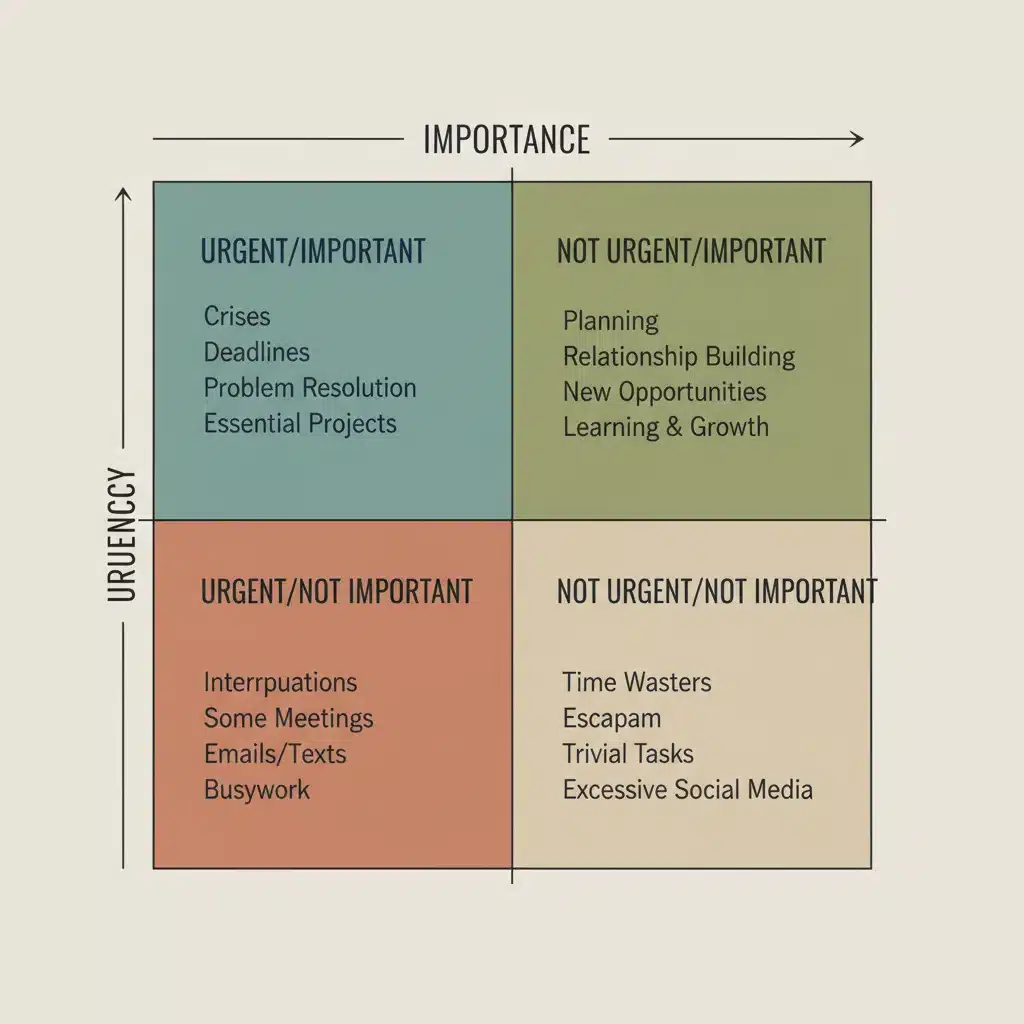
The Eisenhower Matrix (Urgent/Important Matrix)
This tool helps you prioritize tasks based on their urgency and importance, a crucial component of intentional living strategies. Divide your tasks into four quadrants:
- Urgent & Important (Do First): Crises, deadlines, pressing problems.
- Not Urgent & Important (Schedule): Prevention, planning, relationship building, new opportunities. This quadrant is where true intentional living flourishes.
- Urgent & Not Important (Delegate): Interruptions, some emails, certain meetings.
- Not Urgent & Not Important (Eliminate): Time wasters, some busywork.
By focusing on the ‘Not Urgent & Important’ tasks, you proactively work towards your vision and values, preventing future crises and fostering long-term growth. This deliberate focus is a hallmark of strong intentional living strategies.
Parkinson’s Law
This principle states that ‘work expands to fill the time available for its completion.’ By consciously setting shorter, more realistic deadlines for tasks, you can increase your efficiency and reduce procrastination. If you allocate two hours for a task that could realistically be done in one, it will likely take two hours. Apply this law to your daily planning to create focused work blocks, an effective application of intentional living strategies.
The Pomodoro Technique: Maximizing Focus
For deep work and sustained focus, the Pomodoro Technique is invaluable. It involves:
- Working on a single task for 25 minutes (a ‘Pomodoro’).
- Taking a 5-minute break.
- After four Pomodoros, taking a longer break (15-30 minutes).
This technique trains your brain to focus, reduces mental fatigue, and ensures regular breaks. It’s an excellent way to integrate focused work into your intentional daily design, preventing burnout and enhancing productivity, key elements of successful intentional living strategies.
Step 3: Integrating Self-Care and Reflection – The Pillars of Sustained Fulfillment
Designing an ideal day isn’t just about productivity; it’s about holistic well-being. True fulfillment, the 15% increase we’re aiming for, comes from a balanced approach that prioritizes self-care and regular reflection. These are non-negotiable aspects of effective intentional living strategies.
Prioritizing Self-Care and Well-being
Self-care is not a luxury; it’s a necessity for sustained energy, creativity, and resilience. Incorporate self-care activities into your daily schedule as non-negotiable appointments. This could include:
- Physical Activity: Regular exercise is crucial for both physical and mental health.
- Nutritious Meals: Fuel your body with wholesome foods.
- Adequate Sleep: Prioritize 7-9 hours of quality sleep. Your ability to live intentionally is severely hampered by sleep deprivation.
- Mindfulness & Relaxation: Beyond morning meditation, practice deep breathing, listen to calming music, or engage in hobbies that relax you.
- Social Connection: Nurture relationships with loved ones.
- Nature Exposure: Spend time outdoors, even if it’s just a short walk in a park.
Treat these activities with the same importance as your work tasks. They are investments in your long-term capacity to thrive and effectively implement your intentional living strategies.

The Power of Reflection: Daily and Weekly Reviews
Without reflection, even the best plans can go astray. Regular reflection allows you to assess your progress, identify areas for improvement, and realign with your values and vision. This iterative process is a core component of sustainable intentional living strategies.
Daily Reflection (5-10 minutes)
Before bed, take a few moments to:
- Review your day: What went well? What challenges did you face?
- Practice gratitude: List 3 things you are grateful for.
- Plan for tomorrow: Identify your top 1-3 priorities for the next day.
This practice helps you end the day on a positive note, process events, and set yourself up for a successful morning, reinforcing your intentional living strategies.
Weekly Review (30-60 minutes)
Dedicate time each week (e.g., Sunday evening) for a more comprehensive review:
- Review your values and vision: Are your actions still aligned?
- Assess your goals: What progress have you made? What adjustments are needed?
- Evaluate your time: Where did you spend your time? Was it aligned with your priorities?
- Plan the week ahead: Schedule key tasks, appointments, and self-care activities.
- Identify lessons learned: What insights did you gain?
The weekly review is your opportunity to course-correct and ensure you are consistently moving towards your 2026 vision with the aid of your chosen intentional living strategies.
Step 4: Overcoming Obstacles and Maintaining Momentum
Designing an ideal day is an ongoing process, and you will inevitably encounter obstacles. The key to sustained fulfillment lies in your ability to adapt, learn, and maintain momentum. This adaptability is an inherent part of robust intentional living strategies.
Dealing with Distractions and Interruptions
Distractions are an unavoidable part of modern life. Develop strategies to minimize their impact:
- Digital Detox: Schedule periods of time away from screens and notifications.
- Environment Optimization: Create a workspace that supports focus (e.g., tidy, quiet).
- Communication Boundaries: Set clear expectations with colleagues and family about your availability during focused work times.
- Batching Tasks: Group similar tasks (e.g., emails, phone calls) to handle them efficiently in designated blocks.
Proactive management of distractions is a critical component of effective intentional living strategies.
Embracing Flexibility and Imperfection
While structure is important, rigidity can be detrimental. Life happens, and sometimes your meticulously planned day will go off track. The goal is not perfection, but consistent progress and a return to intentionality after deviations. Be kind to yourself, learn from what went wrong, adjust your plan, and move forward. Flexibility is a strength, not a weakness, in the realm of intentional living strategies.
Building Habits for Long-Term Success
The foundation of intentional living is built on habits. Small, consistent actions compound over time to create significant results. Focus on building one new intentional habit at a time until it becomes automatic. Use cues, routines, and rewards to reinforce positive behaviors. Tools like habit trackers can be incredibly helpful. Remember, your ideal day is a collection of intentional habits, forming the bedrock of your intentional living strategies.
Measuring Your 15% More Fulfillment in 2026
How do you quantify something as subjective as fulfillment? While there’s no single metric, you can track your progress and subjective well-being over time. Consider:
- Journaling: Regularly note how you feel at the end of the day. Do you feel more aligned, purposeful, and content?
- Weekly Fulfillment Score: On a scale of 1-10, rate your overall sense of fulfillment each week. Track this over months to see trends.
- Goal Progress: Are you consistently making progress on goals aligned with your values? This is a strong indicator of intentional living leading to fulfillment.
- Energy Levels: Do you feel more energized, less drained, and more present in your daily life?
- Stress Levels: Has your perceived stress decreased as you’ve gained more control and alignment?
The 15% increase is a guiding target, a testament to the power of consistent application of intentional living strategies. You might find your increase is even greater, or perhaps it manifests in ways you didn’t initially anticipate.
Conclusion: Your Journey to a More Intentional and Fulfilling 2026
Designing your ideal day through powerful intentional living strategies is not a one-time event but a continuous journey of self-discovery, adjustment, and growth. By taking the time to unearth your core values, craft a compelling vision for 2026, and apply time-tested personal development frameworks, you are actively choosing to create a life of purpose and profound fulfillment. From the quiet moments of your morning routine to the deliberate prioritization of your tasks, every conscious choice contributes to a richer, more meaningful existence.
Embrace the process, be patient with yourself, and celebrate every small victory. The commitment to intentional living is an investment in your most valuable asset: your life. As you step into 2026, armed with these strategies, you are not just hoping for a better year; you are actively designing it. The 15% increase in fulfillment is within your grasp, a direct result of your dedication to living a life that is truly, beautifully, and powerfully your own. Start today, and watch your ideal day unfold, one intentional choice at a time, guided by robust intentional living strategies.